The 2026 Summer School on Spatiotemporal AI
August 4-6, 2026
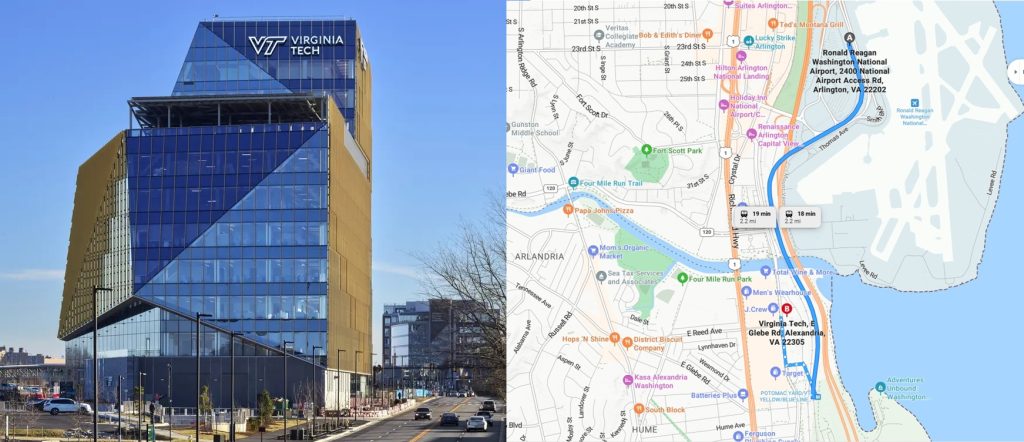
Virginia Tech Academic Building One, 3625 Potomac Avenue, Alexandria, VA 22305
Sponsored by the NSF Spatiotemporal Innovation Center and Virginia Tech, the 2026 Summer School on Spatiotemporal AI offers an intensive, hands-on introduction to the latest advances in spatiotemporal AI, including GeoAI (Geospatial Artificial Intelligence), Generative AI, and Autonomous GIS.
Participants will explore cutting-edge AI-driven geospatial analytics, automation, and predictive modeling through replicable and scalable methods for analyzing complex spatiotemporal datasets for insights. The program highlights how these technologies are transforming decision-making in key domains, including Public Health, Business & Market Analytics, Human Mobility, Remote Sensing & Earth Observation, and Environmental Management.
Attendees will collaborate with leading scientists and industry experts while gaining practical skills in AI-powered spatiotemporal data science.
Core topics: (1) foundations of spatiotemporal AI; (2) advances in cloud computing for spatiotemporal AI; (3) integration of GeoAI and generative AI in research design, spatial modeling, and applications; (4) autonomous GIS; and (5) future trends of spatiotemporal AI.
Tools and Technologies Covered: cloud platforms for spatiotemporal AI, Python-based environments (Google Colab, Jupyter Notebooks), geospatial libraries (GeoPandas, Rasterio), AI-assisted tools (ChatGPT, Gemini and Google Scholar), autonomous spatial analysis, GIS agent development, and applied GeoAI workflows for satellite image analysis, mapping, and spatial intelligence.
Workshop Agenda (August 4 – 6, 2026)
Room: AB1-3100
Day One, August 4, 2026:
9:00 AM – 12:00 PM, August 4, 2026 EDT
I. Foundations of Spatiotemporal AI
1-1: Foundations of GeoAI and Intelligent Systems (35-40 minutes for each presentation)
(Core concepts, theory, and paradigms shaping spatiotemporal AI)
- The Foundation AI Disruption to Research and Education (Chaowei Yang)
- GeoAI: The New Frontier (Siqin Wang)
- GeoAI: Turning Data into Public Health Impact (Xiao Huang)
- GeoAI and Smart Disaster Mitigation (Qunying Huang)
1:00 PM – 5:00 PM, August 4, 2026 EDT
1-2: Hands-on Practice: AI-Assisted Analysis with Python in Google Colab (Anusha and Andrew)
- Cloud Computing with Python in Google Colab
- AI Copilot for Geospatial Data Analysis
- Data Mapping with GeoPandas
- Satellite Image Analysis with Rasterio
- Case Study: Urban Poverty and Healthcare Access
Day Two: August 5, 2026
9:00 AM – 12:00 PM, August 5, 2026 EDT
II. Advances in Spatiotemporal AI: Human-Centered AI Analytics and Decisions
2-1: Advances in Spatiotemporal AI: Autonomous GIS and Generative AI for Analytics and Decisions (35-40 min for each presentation and demo/hands-on practice)
(Understanding, governing, collaborating, and decision with AI systems)
- Foundations of Autonomous GIS and Agentic Geospatial Systems (Zhenlong Li)
- Human-AI Collaboration in Autonomous Spatial Analysis, Modeling, and Research (Zhenlong Li and Temitope Akinboyewa )
- Research Architect: A Human-in-the-Loop Research Architecture (Ning Huan and Xiao Huang)
- Demos and Hands-on Practices (Temitope Akinboyewa and Zhenlong Li )
1:00 PM – 4:00 PM, August 5, 2026 EDT
2-2: Hands-on Practice: Generative AI Tools for Research and Writing
- Using ChatGPT as an Assistant for Writing (Seren Smith)
- AI Assisted Research Design (Qunying Huang)
- Case Study: Wildfire Research (Qunying Huang)
- Case Study: Wildfire Spread Modeling (Manzhu Yu)
Day Three: August 6, 2026
9:00 AM – 12:00 PM, August 6, 2026 EDT
III. Spatiotemporal AI Applications and Future Trends
3-1: Applications and Societal Impact (30 minutes for each presentation)
(Real-world deployment across domains and challenges)
- GeoAI for Regional Conflicts (Yahya Masri and Zifu Wang)
- From Decision Trees to Deep Learning (Lingbo Liu)
- GeoAI Applications for Transportation Environments and User Experience Auditing (Armita Kar)
- Generative AI workforce and Job Market (Qifan Wu and Xiao Huang)
- GeoAI for Healthcare Analytics (Mengxi Zhang)
- GeoAI for Historical Map Information Extraction (Shoibolina Kaushik and Xiao Huang)
- GeoAI for Urban Representations (Yuhao Jia and Xiao Huang)
- Generative AI for Smart Urban Management (Junghwan Kim)
1:00 PM – 4:00 PM, August 6, 2026 EDT
3-2: Panel Discussion:
- Future Trends of Spatiotemporal AI
- Open Discussion
Requirements:
A background in geographic analysis or related fields is desirable. All participants are expected to actively engage in class assignments and group and discussions. Participants who successfully complete the program will receive a certificate of completion. Outstanding participants will be invited to join the research team of the Spatiotemporal Innovation Center project.
Application:
Please submit your application via the following form: https://forms.gle/2HMnUUymHxc3eK4w7 before May 30, 2026. Application will be open until all seats are filled.
Detailed agenda and lodging information will be provided to accepted participants. Participants are responsible for their own travel and accommodation expenses.
For more information, please visit https://stds.stcenter.net or contact: office@spatialdatalab.org.
Registration Fee:
- $1,980 registered/paid before 0:00 am ET, June 30, 2026
- $2,680 registered/paid after 0:00 am ET, June 30, 2026
Lecturers:
- Chaowei Yang, George Mason University
- Siqin Wang, University of Southern California
- Xiao Huang, Emory University
- Qunying Huang, University of Wisconsin
- Zhenlong Li, The Pennsylvania State University
- Manzhu Yu, The Pennsylvania State University
- Zifu Wang, Harvard University
- Lingbo Liu, Harvard University
- Armita Kar, George Mason University
- Mengxi Zhang, Virginia Tech
- Junghwan Kim, Virginia Tech
Instructors:
- Anusha Srirenganathanmalarvizhi George Mason University
- Andrew Yang, Northeastern University
- Temitope Akinboyewa, The Pennsylvania State University
- Yahya Masri, George Mason University
- Ning Huan, Emory University
- Seren Smith, George Mason University
- Qifan Wu, Emory University
- Shoibolina Kaushik, Emory University
- Yuhao Jia, Emory University

Location:
The in-person sessions will be held at Virginia Tech Academic Building One, 3625 Potomac Avenue, Alexandria, VA 22305, which is less than 2 miles from the Ronald Reagan Washington National Airport. Online participants will receive a Zoom link prior to the event.
Contact: Please contact office@spatialdatalab.org if there are any questions.